Blog
From Docs to Dialog
Documentation is essential. Reading documentation is… less enjoyable.
We’ve all been there: you’re confident the answer is somewhere in the docs, but after twenty minutes of Ctrl+F and clicking through navigation trees, you’re still hunting. What if you could just ask?
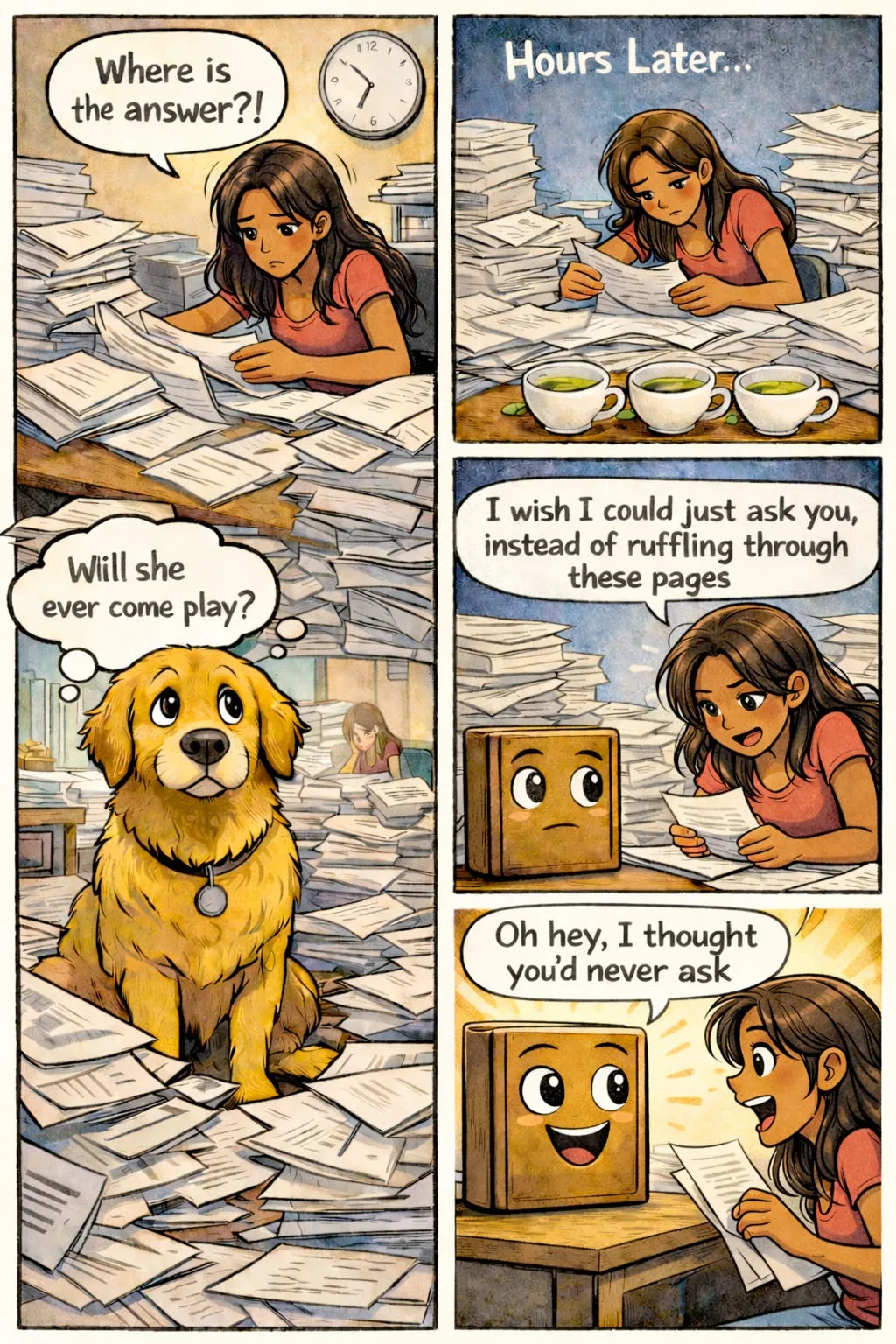
But hang on — don’t get too excited
You can just ask. LLM-wrapped chatbots are a dime-a-dozen by now. However here’s how it often goes:
You: “How often should I water my cactus?” Bot: “Cacti thrive with consistent moisture. Water your cactus thoroughly every 2–3 days, ensuring the soil stays damp. You: (cactus dies) You: “Cacti rot if you over-water them. I should have watered it once a month.” Bot: “You’re absolutely right! I apologize for the confusion.”
The problem is that most RAG implementations treat your docs as a bag of text chunks, retrieve the closest matches, stuff them in a prompt, and hope for the best. Structure? Relationships? Context? Lost in the chunking.

We thought we could do better. And we had the tools to prove it.
Just as the first C compiler was written in C. The first Embabel learning tool was built with Embabel. Say hello to Embabel Hub 👋
What is Embabel Hub?
Right now, Embabel Hub is your starting point for exploring the Embabel agent framework. At its core, it’s a documentation site with a twist: an AI-powered guide named Jesse who actually understands the docs.
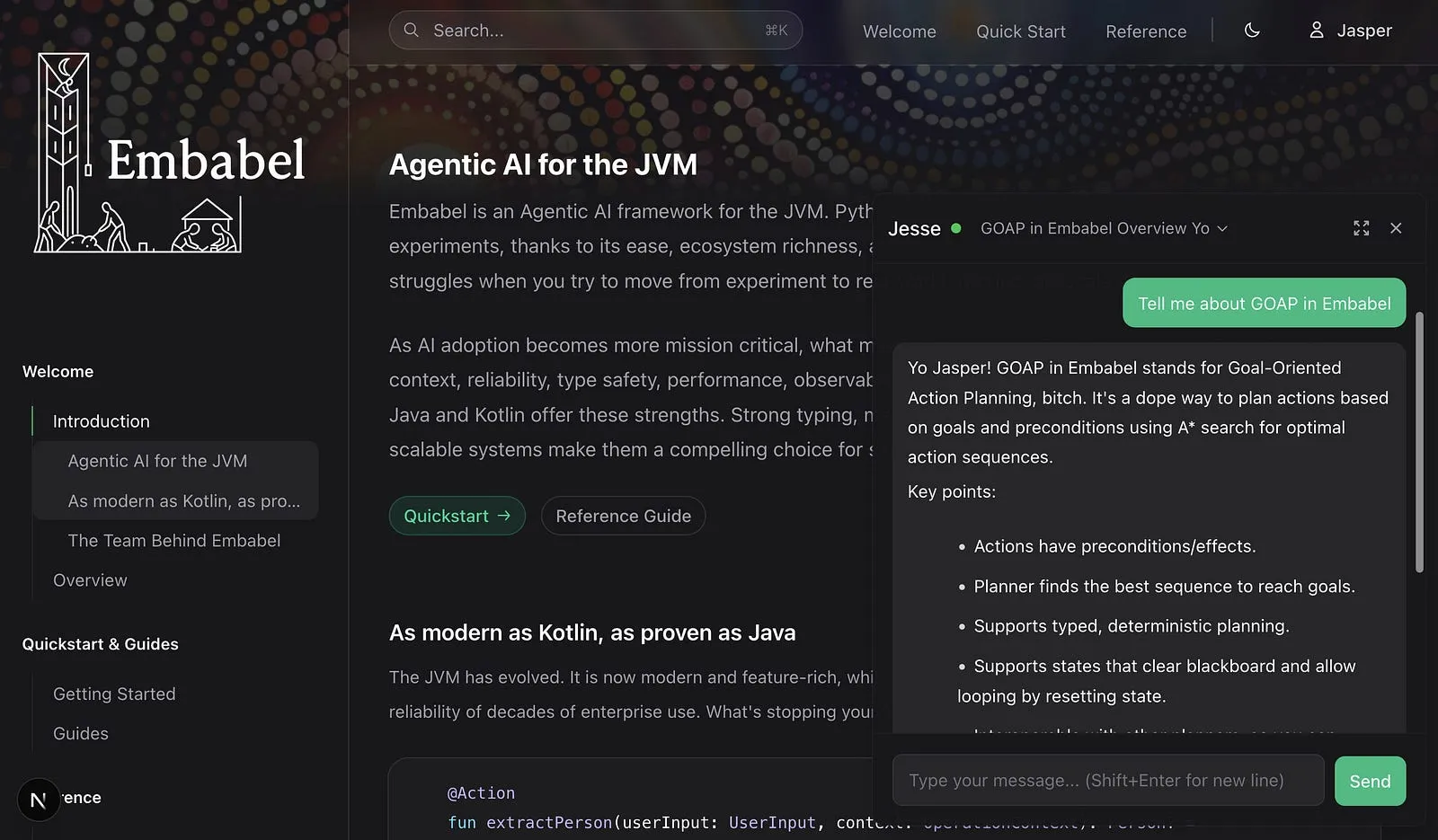
Ask Jesse a question like:
“What’s the difference between an Agent and a Chatbot in Embabel?”
And you’ll get a coherent answer synthesized from the documentation. Not a list of search results to sift through, but an actual explanation with context.
Try it yourself! Embabel Hub is available for early access:
docker run -d \
 -- name embabel-hub \
 -p 21337:1337 \
 -p 27474:7474 \
 -p 27687:7687 \
 -p 8042:8042 \
 -v embabel-neo4j-data:/data \
 -v embabel-neo4j-logs:/logs \
 -e OPENAI_API_KEY=$YOUR_OPENAI_API_KEY \
 embabel/hub:latest
Then visit http://localhost:8042, login in, and start a conversation!
The 42 in the port name above is a throwback to Douglas Adam’s Hitchhiker’s Guide to the Galaxy. Do you know what that refers to? It is worth finding out if you don’t ;)
The Bootstrap in Action (aka eating the dogfood)
Here’s where two stories converge: Jesse obviously isn’t built with some external AI framework. Naturally, we’re using Embabel to build the tool that helps people learn Embabel.
Every conversation with Jesse exercises the same agent architecture, tool integration, and in this case, conversation management that you’d use in your own Embabel applications.
A Peek Under the Hood: RAG Done Right
Jesse’s knowledge comes from Retrieval-Augmented Generation (RAG), whichis a technique where an LLM’s responses are grounded in actual source documents rather than relying solely on training data.
But not all RAG is created equal. The typical approach:
- Chop documents into chunks 2. Generate embeddings for each chunk 3. Store in a vector database 4. On query, find similar chunks and stuff them into a prompt
This can give promising results, but it loses something important: structure.
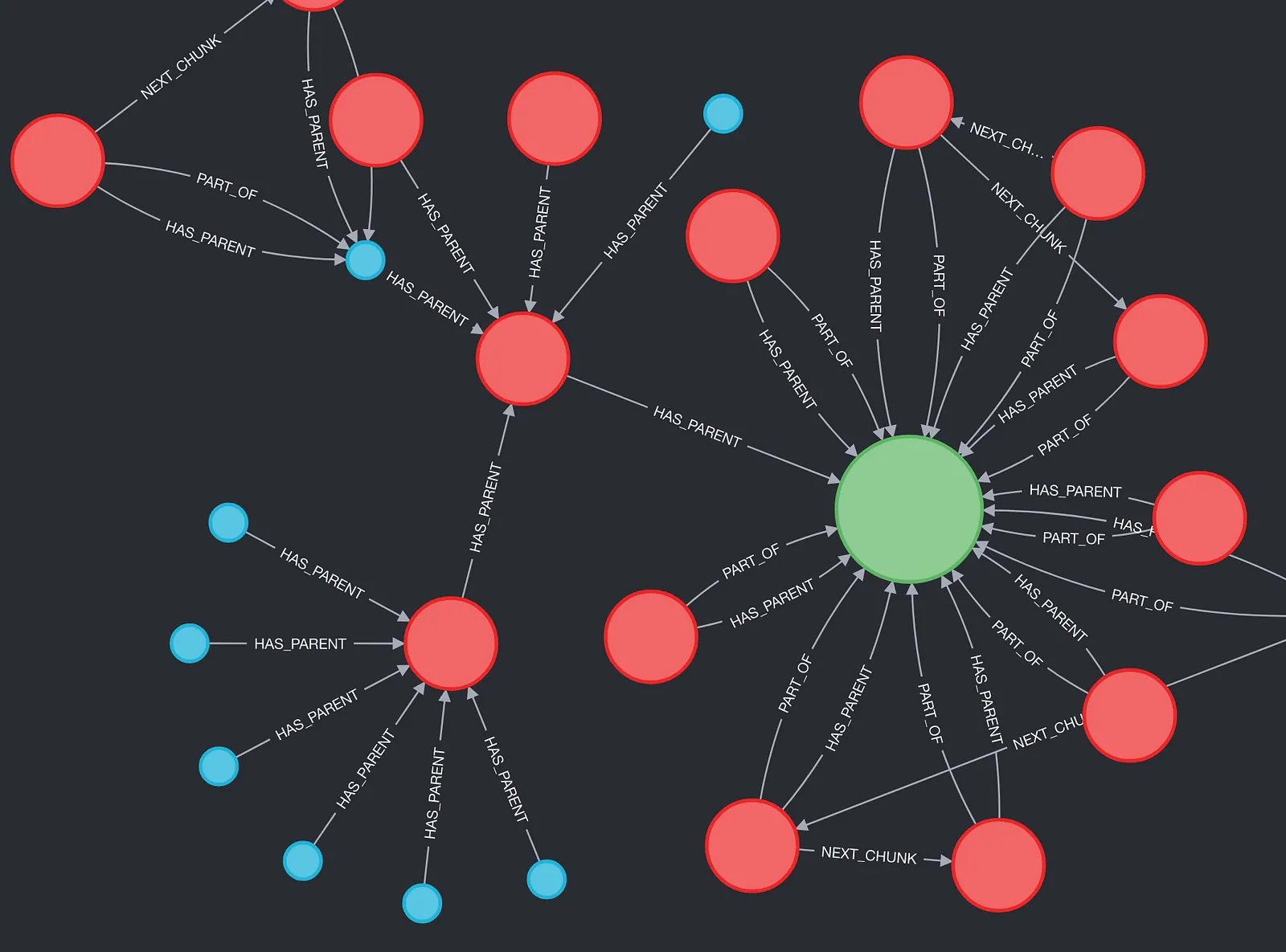
Documentation isn’t a bag of paragraphs. It has hierarchy like sections, subsections, code examples that relate to explanations. It has relationships — concepts that link to other concepts, APIs that depend on other APIs.
Graph-Powered RAG with Embabel
Embabel’s RAG implementation preserves this structure using a knowledge graph (powered by Neo4j and my Drivine persistence layer):
- Hierarchical relationships — chunks know their parent sections, documents know their table of contents
- Semantic links — related concepts are connected, not just co-located by vector similarity
- (Coming shortly) Entity awareness — named entities (classes, methods, configuration keys) are first-class citizens, not just substrings
When Jesse retrieves context for your question, it’s not just finding “similar text.” It’s navigating a knowledge structure that mirrors how the documentation was actually organized.
The result: more coherent answers with better context, and fewer hallucinated details.
At the time of writing entity awareness hasn’t been integrated in Guide. If you’re curious check it out in the Impromptu project. Andreas Kolleger, from Neo4j, will also be presenting Rod’s work on this at JFocus (early Feb 2026). If you miss that, we’ll publish a deeper dive in an upcoming blog post.
Toolish RAG: Agentic Search
But Jesse doesn’t stop at structured retrieval. There’s another problem with traditional RAG: the retrieval step is a black box. The system performs one search, grabs some chunks, and hopes they’re relevant. What if the first query doesn’t find what you need? What if the answer spans multiple documents that aren’t connected by vector similarity?
One of the ideas we use comes from Rod Johnson, who calls it Toolish RAG. It flips the script: instead of a single retrieval step, it gives the LLM tools to search the knowledge base directly. The model decides when to search, what queries to use, and whether to dig deeper. It can:
- Try different query strategies — if semantic search doesn’t find it, try full-text search with specific terms
- Expand context — zoom out from a chunk to see its parent section, or broaden to include surrounding chunks
- Follow references — when one document mentions another, the LLM can look it up
- Use HyDE — generate a hypothetical answer first to improve semantic matching
This is particularly powerful for code search. When Jesse needs to explain how something works in Embabel, it doesn’t just search documentation. It can search the actual codebase, find relevant classes and methods, and cite specific implementations.
Setting up a Toolish RAG
So that sounds pretty powerful, right? It stands to reason that setting up a toolish RAG must take quite a few lines of code?
Nah.
Here’s what that looks like in practice:
@Action(canRerun = true, trigger = UserMessage.class)
void respond(Conversation conversation, ActionContext context) {
 var assistantMessage = context
 .ai()
 .withLlm(guideProperties.chatLlm())
 .withReference(new ToolishRag(
 "docs",
 "Embabel docs",
 drivineStore
 ).withHint(TryHyDE.usingConversationContext()))
 .withTemplate("guide_system")
 .respondWithSystemPrompt(conversation, templateModel);
 conversation.addMessage(assistantMessage);
}
That’s it. A few lines to create a ToolishRag instance, attach it to an LLM call, and the model gains autonomous access to vector search, text search, chunk expansion, and more. All backed by the Neo4j knowledge graph.
If you’re interested to know more about Toolish RAG, here is a post by Rod Johnson. There is a sample application Github that dives deeper on the topic.
Exposing MCP Tools
We’ve even exposed these same tools via MCP, so you can use them from Claude Desktop or any MCP-compatible client too:
@Bean
McpToolExport documentationRagTools(DrivineStore drivineStore) {
 return McpToolExport.fromLlmReference(
 new ToolishRag("docs", "Embabel docs", drivineStore),
 properties.toolNamingStrategy()
 );
}
The full implementation is available in the source code: https://github.com/embabel/guide
What Makes Embabel Different
Whether you’re coming from Python AI frameworks or you’re a JVM veteran exploring agents, here are a few features that made building Jesse with Embabel a joy to build with.
- Type-safe LLM outputs — LLM calls return real objects, not strings you have to parse. Read more about that here (or ask Jesse ;).
- Composable prompts — prompts are built from reusable, testable Jinja templates. Read about that here or … you know what to do ;)
- Agent-first design — retrieval, tools, memory, and flow are explicit parts of the model. We delved into that in this post, and will be talking more in future posts.
What’s Next for Embabel Hub?
Today, Hub is focused on documentation. But we see it evolving into a broader platform for the Embabel ecosystem:
- Agent Playground — experiment with agent configurations in a sandbox environment
- Integration Templates — starter projects for common use cases
- Community Showcase — see what others are building with Embabel
We’re building in the open and would love your input on what would be most valuable. Let’s see where this goes together.
Join the Bootstrap
Embabel Hub is in early access, which means:
- Things might break (let us know!)
- Your feedback directly shapes the roadmap
- You’re among the early explorers of Embabel. While the community is still taking shape, the people here now have an outsized influence on where it goes next.
Every bug you find, every question you ask Jesse, every feature you request — it all feeds back into both the Hub and the framework that powers it.
After a while incubating, the early access version will graduate to a cloud version. Shout-out to Michael Hunger, Andreas Kolleger and the folks at Neo4j for providing us a database instance!
A note on open source: Just about all of Embabel, including the Jesse guide is open-source. The Hub UI isn’t open-sourced yet, but several users have asked. We’re happy to do it. If that would be useful for you, let us know! The more the community wants it, the higher it climbs on the priority list.
Get Involved
The best thing about open source is that we can shape it together.
Pull the image, ask Jesse some questions, and come build with us:
- Docker Hub (early access): embabel/hub
- GitHub: Star the repo, open issues, submit PRs
- Guide/Jesse Source: See how it’s built — github.com/embabel/guide
- Discord: Join the community, ask questions, share what you’re building
Together we can build something great for the JVM ecosystem and beyond. We’re building Embabel with Embabel. Come build with us.
— -
Coming soon: a deeper dive into Drivine, the graph persistence layer that powers Embabel’s knowledge graph and makes structured RAG possible.